If you ask Nonna Do why most store-bought orchids fail at home, her answer never changes: “Too much love.” Orchids are rarely neglected to death. Much more often they drown, watered too often, in the wrong way, at the wrong time. In Chapter 10 of her book, The Art of Orchids, Dorina calls watering “not a task, but a relationship.” Once you learn to read your orchid, it becomes one of the most calming minutes of your week. Let’s clear away the myths first.
Myth 1: “Water your orchid once a week, like clockwork.”
The truth: orchids want rhythm, not routine.
How fast a pot dries out depends on the season, humidity, pot size, potting medium and light. A calendar can’t account for any of that. Your orchid can. Water when you see these signs:
- Roots in the pot have turned silvery-white
- The pot feels noticeably lighter when you lift it
- The bark is dry to the touch an inch or so down
Hold off if the roots are still green, the pot feels heavy, or there are water droplets on the inside of a clear pot.
Nonna’s Tip: Lift your orchid right after watering and remember how heavy it feels. A few days later, lift it again. Your hands will quickly learn the difference between “drinking” and “thirsty.”
Myth 2: “Three ice cubes a week is all an orchid needs.”
The truth: ice is a shortcut, not a method.
The ice cube idea became popular because it keeps beginners from pouring in too much water. A few cubes won’t kill a sturdy Phalaenopsis overnight, but it’s a poor habit. Orchids are tropical plants, and cold meltwater chills their roots and can pool at the crown. Worse, a trickle of meltwater never soaks the bark evenly and never flushes out the fertilizer salts that build up over time. A thorough drink of room-temperature water, fully drained, does everything the ice cube can’t.
“Ice belongs in cocktails, not orchids,” Dorina says, with a wink.
Myth 3: “Orchids like to stay moist all the time.”
The truth: wet roots are dead roots.
Most popular orchids are epiphytes. In nature they grow on tree branches, with roots that catch a rain shower and then dry out in the breeze. Their roots are covered in a spongy layer called velamen, which soaks up water quickly and then needs air. Keep them constantly wet and the roots suffocate and rot.
Dorina’s rule is easy to remember:
- Moist roots + airflow = healthy
- Wet roots + still air = rot
There are exceptions. Oncidiums, Paphiopedilums (slipper orchids) and Miltoniopsis like to stay evenly moist, but never soggy.
Myth 4: “Misting the leaves counts as watering.”
The truth: misting is a supplement, not a substitute.
A light morning mist can raise humidity around the leaves for a little while and refresh a plant on a hot day. It doesn’t soak the potting medium or hydrate the roots, which is where an orchid does its drinking. If you mist, do it only in the morning so the leaves dry before dark. Moisture sitting on leaves and petals overnight invites fungal spots, especially on white flowers.
Myth 5: “Clear pots are just for looks.”
The truth: a clear pot is the best watering teacher you can buy.
With a clear plastic pot you can see root color, moisture, condensation and the condition of the bark without disturbing the plant. That’s why Dorina keeps her Phalaenopsis in clear pots and sets them inside a prettier cachepot for display. Just remember to lift the inner pot out to water and drain it.
Myth 6: “It doesn’t matter what time of day you water.”
The truth: morning is best.
Water in the morning or early in the day. The plant has hours of light and air movement to dry off, which is exactly the wet-then-dry cycle its roots evolved for. Watering at night leaves the bark and crown damp through the coolest, stillest hours, and that’s when rot and fungus thrive. Her rhythm fits on a note card: “Morning light, morning water.”
Myth 7: “All orchids should be watered the same way.”
The truth: every orchid has its own thirst.
| Orchid | How it likes to drink | Typical interval* |
|---|---|---|
| Phalaenopsis | Water when roots turn silver; slight dry-down | 5–10 days |
| Cattleya | Dry out almost completely between waterings | 7–14 days |
| Oncidium & Brassia | Keep lightly moist; never bone-dry | 4–7 days |
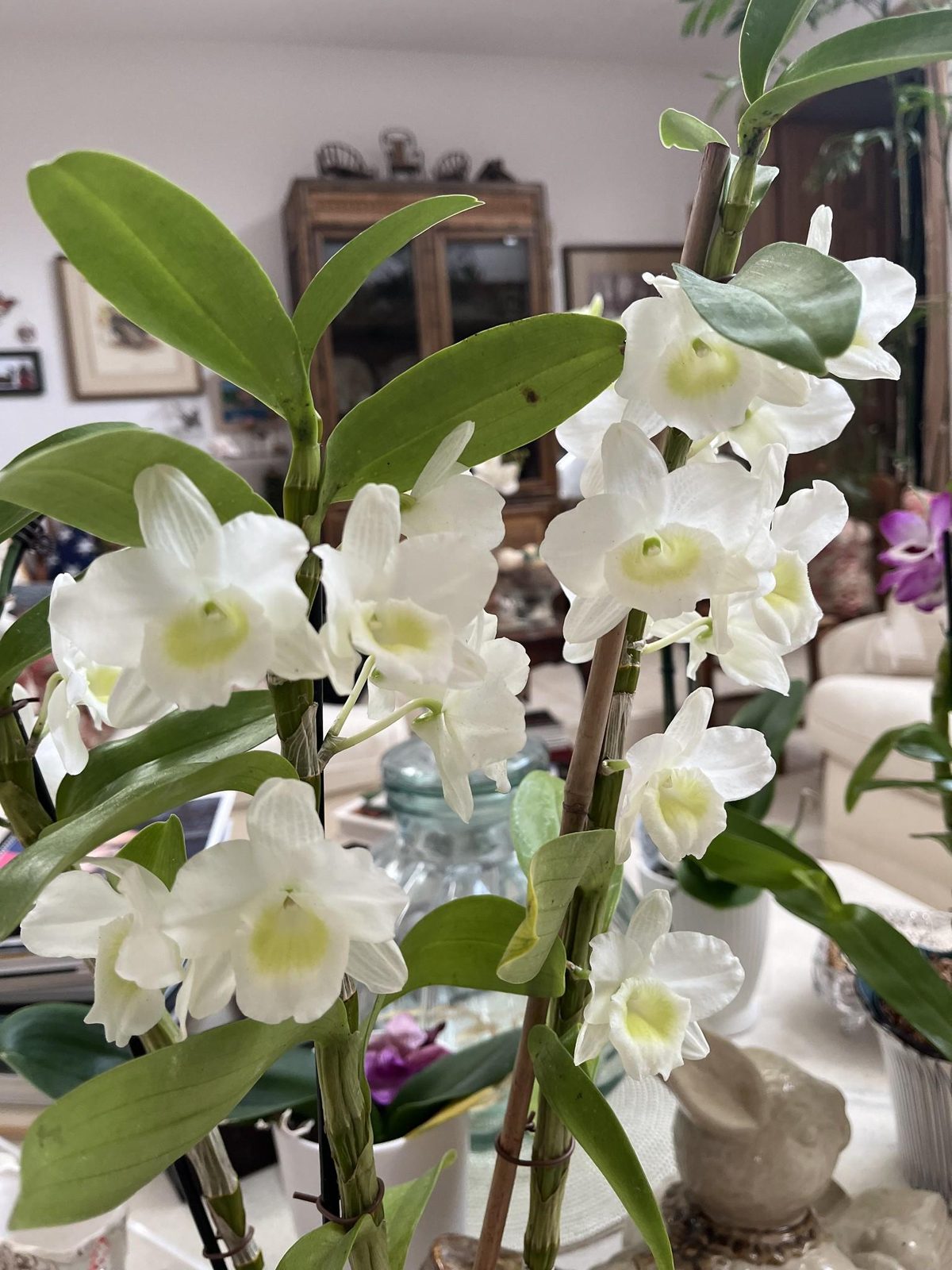
| Dendrobium | Generous in summer growth; much less in winter for cane types | 5–10 days in growth |
| Paphiopedilum | Evenly moist, no hard dry cycles | 4–7 days |
| Vanda (bare root) | Soak or drench daily in warm weather | Daily |
*Just a starting point. Your roots, your pot and your home have the final say.
The Science of Root Color
In Dorina’s book, this is where watering finally clicks for most people. Healthy orchid roots change color as they fill with water and dry out, because the velamen turns see-through when it’s wet.
| Root color | What it means | What to do |
|---|---|---|
| Silvery-white, firm | Dry and healthy | Time to water |
| Bright green, plump | Freshly watered | Wait |
| Green tips (shiny, rounded) | Active new growth | Perfect conditions; don’t disturb |
| Olive or brownish, limp | Staying wet too long | Water less; check your bark |
| Brown or black, mushy | Root rot | Trim and repot in fresh medium |
| Papery, shriveled | Dehydration or salt burn | Check roots; water and flush thoroughly |
Her kitchen-garden test for a questionable root: “If it snaps like a carrot, it’s healthy. If it smears like a banana, it’s gone.”
The Dorina Method: How to Water, Step by Step
- Use room-temperature water, preferably rainwater, filtered or distilled.
- Bring the orchid to the sink.
- Water from above and let it run through the bark for about 30 seconds, soaking the roots.
- Let the pot drain completely.
- Never let the pot sit in a saucer or cachepot of standing water.
- If water lands in the crown (the center of the leaves), dab it dry with a paper towel.
- Return the plant to bright, indirect light.
Once a month, give a flush: run plenty of plain water through the pot to rinse away fertilizer salts. Those salts are what cause brown leaf tips.
Humidity: The Secret Partner
Humidity changes everything. At 45–65% humidity, roots stay plump longer and flowers last longer. In dry winter air, pots dry out faster and buds may drop. Dorina’s Mediterranean trick is a tray of pebbles and water under the pots. The pots sit on the pebbles, not in the water. It’s a small daily kindness, like the sea air on her home island of Cres.
“Water slowly. Watch closely. And remember—you are not watering a pot… you are nourishing a soul.” — Nonna Do
Nonna’s Takeaway
Forget the calendar and the ice tray. Look at the roots, lift the pot, water deeply in the morning and let everything drain. In Croatian, voda means water. In Italian it’s acqua. In any language, your orchid wants it in balance.
New to orchids? Start with Dorina’s 10 Golden Rules. When your bark starts breaking down, follow our step-by-step repotting guide. You’ll find more of Mom’s wisdom in the Orchids section.
Keep exploring: Orchid Types 101 · How to Make Orchids Rebloom · Nonna’s Garden

Mother, Nonna, orchid grower, cook, tailor and artisan — born in Belej on the island of Cres, Croatia. Written with love by her family, sharing the wisdom she gave us. Read her story →